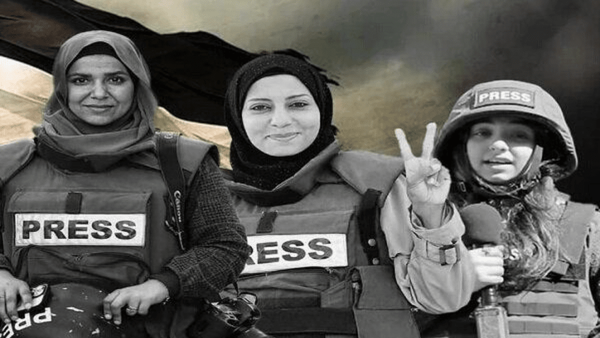
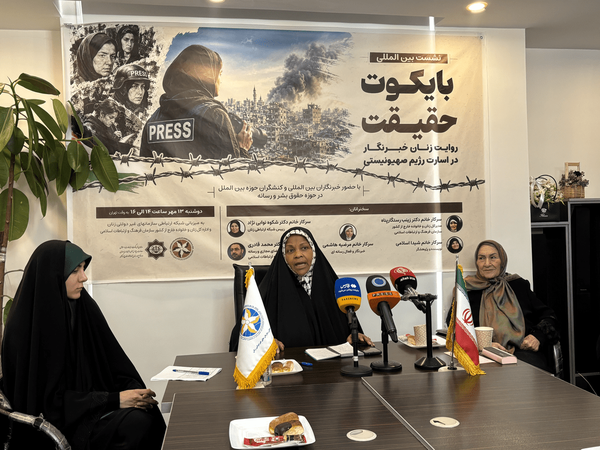
The human rights meeting "Boycotting the Truth: The Narratives of Women Journalists in the Captivity of the Zionist Regime" was held with an emphasis on the role of women journalists in the war of narratives and an explanation of the pressures, arrests, and restrictions imposed on them.
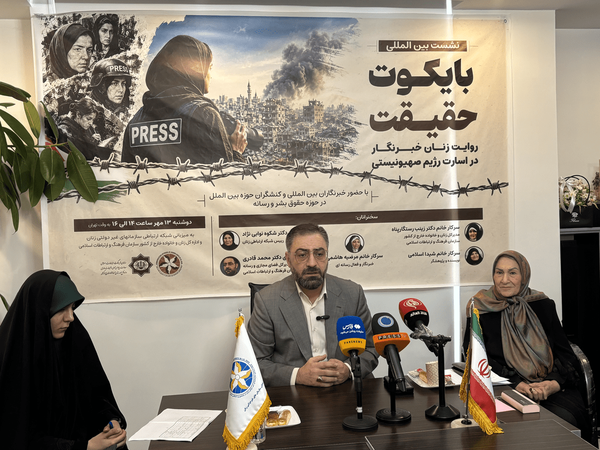
Fars News Agency _ Media Group: An online human rights meeting on the topic of "Boycotting the Truth; Narratives of Women Journalists in Captivity by the Zionist Regime" was held with the participation of the Women's Non-Governmental Organizations Communication Network and the Islamic Culture and Communications Organization. This meeting was held online today, Monday, October 4, with the presence of a group of activists in the fields of women, media, and human rights. Shokoh Navabinezhad, head of the Women's Network, Mohammad Ghaderi, director of the Islamic Culture and Communications Organization, and Marzieh Hashemi, journalist and host of Press TV, and a group of media activists were present at the meeting.
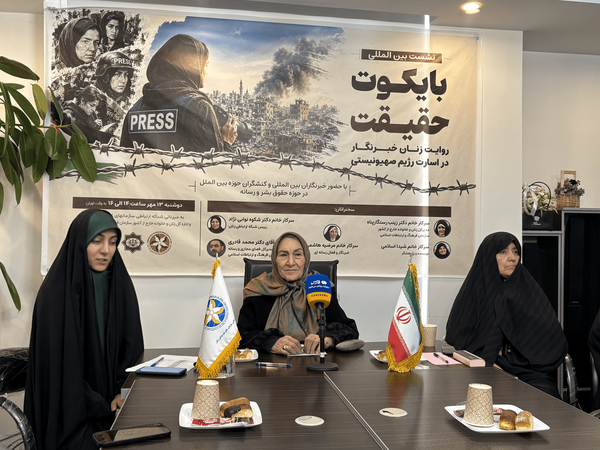
Shokoh Navabinezhad, the head of the Women's Communication Network, said at the meeting, referring to the formation of this network: "In 1995, the largest women's congress was held in Beijing, and a number of women's activists from Iran attended this congress. After this trip, with the efforts of Ms. Habibi, we decided to launch the Women's Network, and this network was formed as the first women's network in Iran." She continued: "This network operates at both national and international levels. At the national level, we have representatives in all provinces, and about 480 non-governmental members are present in the network." In the international arena, we have also been pursuing our international activities since 1997, when the network became a member of the United Nations Council. Referring to the activities of the network's working groups, the head of the Women's Communication Network stated: The network's activities are pursued in the form of 15 working groups, including research, charity, health, environment, law, and various other areas. Referring to the topic of today's meeting titled "Truth Tellers," Navabinejad said: In a world where documents and laws have been carefully and delicately drafted to protect human dignity, we are witnessing systematic violations of human rights in action. At the forefront of this disaster, two groups are paying the price more than others; first, journalists, and second, women, who are the main victims of this situation. He added: Journalism in wartime is fulfilling a human responsibility, recording history, and trying to save people, but today, journalists' cameras and pens have become targets for repression. In addition to physical deprivation, women also face a serious blow to the foundation of the family through their captivity and detention.
The head of the Women's Communication Network emphasized: "International judicial institutions, including the International Criminal Court, must prosecute the perpetrators of attacks on journalists and violations of the rights of civilians. We cannot talk about peace while pens are broken, cameras are turned off, and women are imprisoned." Navabinejad continued: "Our solidarity within the framework of legal standards must come to the aid of these people and not let war triumph over truth." We at the Women's Network do not limit ourselves to expressing sympathy, but as a non-governmental network, we call for immediate and international action. We call for the immediate and unconditional release of journalists and photojournalists, as well as an end to the arbitrary detention of women in any form and by any means by the Zionist regime."
Mohammad Qaderi, Director General of Cyberspace and Media of the Islamic Culture and Communications Organization, referring to his 25-year experience in journalism and news, said: "I consider the presence of women in the field of narrative and media to be a matter of struggle; because at first glance, it may seem that the presence of women in the fields of war and armed conflicts is not very necessary, but by examining the developments in recent years and the changing nature of conflicts, we see that wars have transformed from a one-dimensional battle into hybrid wars." He added: "One of the most important dimensions of hybrid wars is cognitive and perceptual warfare. In the recent war between the Zionist regime and the United States against Iran, the role of narrative was also very important. In such circumstances, when the international arena has undergone serious changes, the tools used to convey messages and narratives have also changed." The Director General of Cyberspace and Media of the Islamic Culture and Communications Organization continued: "Every person who is in the position of the media, human medium or narrator, should pay attention to the extent to which his presence and participation in such a space can be effective." If we go back to history, we see that women who have taken on the task of storytelling have had a clear impact to this day. Qaderi noted: "When the truth is narrated, the element of emotion and feeling is also involved, and this can increase the impact of the narrative. The importance of this issue is such that today the enemy is trying to limit the field of storytelling, and naturally, a female narrator who works independently of Western media channels is considered a serious challenge for the enemy's think tank."
Referring to the role of Hazrat Zainab (PBUH) in the narration of the Ashura incident, he stated: "Since the time of Ashura, when Hazrat Zainab (PBUH) narrated that incident, the importance of women's narratives can be seen. In the past three years and after October 7, we have witnessed that despite the use of hard and soft tools to establish a specific narrative, this narrative has not been able to maintain its first and last narrative in its possession. Even Netanyahu admitted last year that the Zionist regime is lagging behind in the soft war." The Director General of Cyberspace and Media of the Islamic Culture and Communication Organization stated: "In these circumstances, technology on the one hand and the personality traits and character of the individual who is responsible for transmitting the message on the other hand determine whether a narrative will survive or perish." Qadri said: "Today, whether from the perspective of communication and media science or from the perspective of ideological beliefs, the effective role of women journalists in both streams can be realized. This is a scientific data and a proven fact." The role of a female fighter and a woman who believes in the victory of her front is very effective in transmitting and perpetuating the narrative. Referring to the martyrdom of female journalists during the Gaza war, she added: "In previous years, we have witnessed examples such as the martyrdom of the female journalist from Al Jazeera and we saw what a wave this event created in the media. Even on social networks, female narrators play an important role, and based on the analyses conducted, algorithms such as meta-algorithms, despite attempts to boycott some narratives, in some cases give more feedback to narratives presented by women."
Marzieh Hashemi, a journalist and media activist, continued the meeting, referring to the situation of journalists imprisoned by the Zionist regime, saying: Right now, about 40 journalists are still in the prisons of the Zionist regime and have not been released. On the other hand, a large number of journalists have also been martyred during the Gaza war. She added: The incident we are talking about today is still happening, and for this reason, various organizations and institutions must take more serious measures to defend the rights of journalists and the Palestinian people. Genocide by the Zionist regime is not a new issue, but this situation has become more intense in the past three years and since October 7. Stating that today we must move beyond the stage of recognizing the situation and seek a solution, the journalist said: We have known the Resistance Front for years, but today we must see what we can do to support the journalists who are on the front lines.
Hashemi continued: Today, there are children who are active in the media with their mobile phones and are trying to convey to the world what they see in the field. On the other hand, the Zionist regime has never allowed international journalists to freely enter Gaza. If international journalists were not allowed to enter Iran, see what a fuss they would make in the Western media. Referring to the high number of martyred journalists in Gaza, he said: In these three years, we have seen many images of crimes; images that were very difficult and shocking for any human being to see. Journalists were also targeted in the same conditions and we even witnessed cases of journalists being burned. Referring to his relationship with one of the journalists in Gaza, Hashemi stated: I was personally in touch with one of the journalists in Gaza and we were in constant contact. He always said that at any moment we may know that we are in the last moment of our lives, but we will continue our activities until the last second. Their house has also been targeted for about two years.
The journalist and media activist emphasized: "We must not allow this situation to become normal. We must put pressure on everyone we can to make the voices of journalists who are on the front lines and under pressure heard." Hashemi concluded: "Journalists are on the front lines and under extreme pressure, and today we must ask ourselves what we can do to support them and prevent this situation from becoming normal."